How to not lose a single lead at your next trade show
A founder's playbook for exhibitors: set up one capture flow before the show, a ten-second routine at the booth, same-evening triage, and follow-up inside 72 hours.
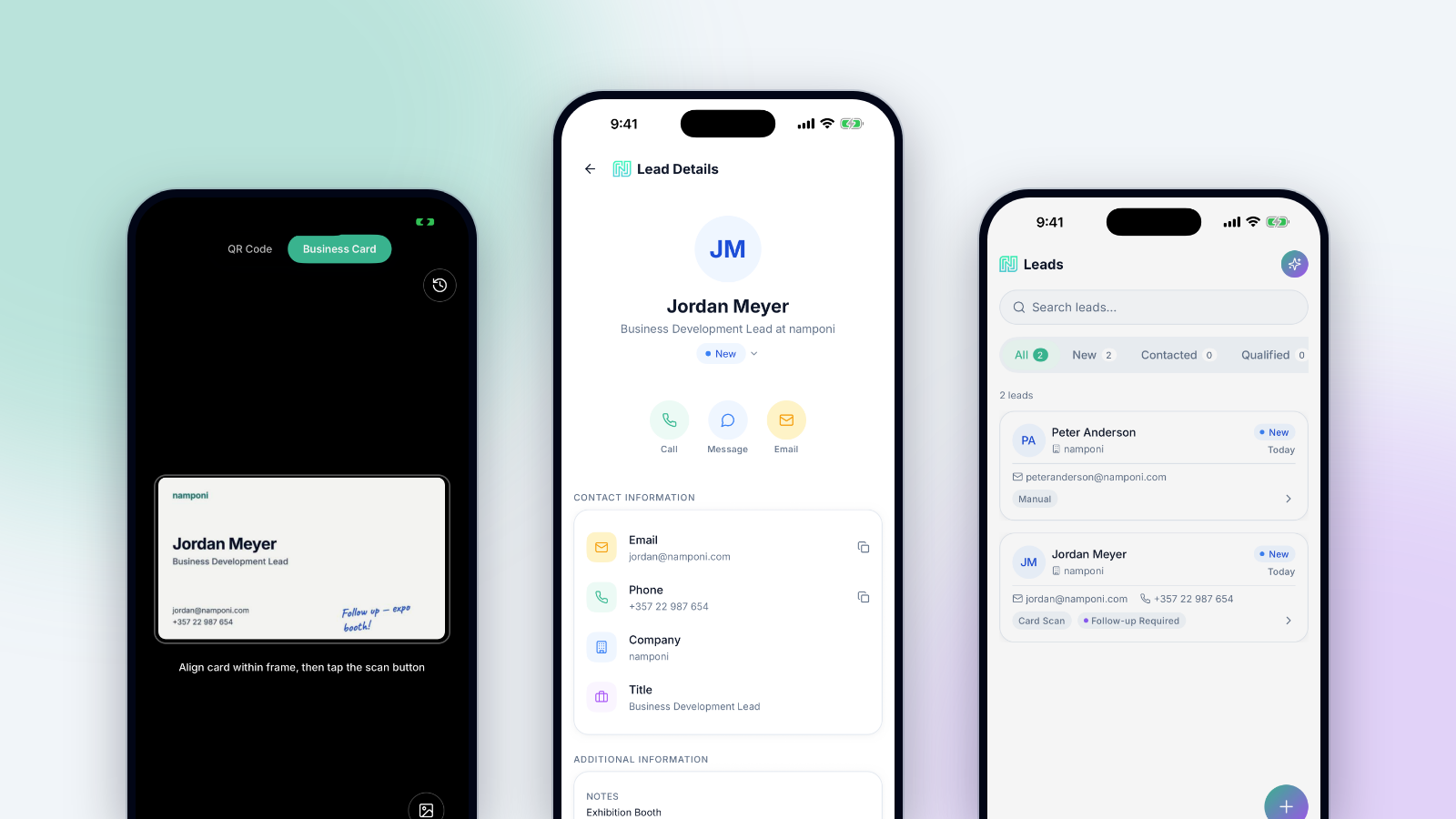
Every exhibitor I know has the same drawer. It holds the business cards from the last show: a lanyard pouch full of them, a few pages of notes that are only half legible, and a clear memory of a handful of conversations out of the dozens that happened. A couple of weeks later a few of those people got an email. The rest never heard from you. I build software for exactly this problem, and I have that drawer too.
I am the founder of namponi, an app for digital business cards, smart QR codes and AI card scanning that turns the people you meet into leads you can actually follow up. This guide is the routine I now use at shows, written for exhibitors who work a booth with a small team and cannot afford to waste the leads they paid a lot of money to meet.
None of it requires namponi. Where a screenshot helps, I show how a step looks in the app, because that is the tool I have on my phone.
Why do trade show leads go cold?
Leads go cold because the information that made a conversation valuable lives in your head, not in the card. Who they were, what they asked, what you promised: none of that is printed on the cardboard. By the time someone types the stack into a spreadsheet, the context is gone, and a name without context is not a lead.
You will read online that "80% of trade show leads are never followed up". I have seen that number attributed to CEIR, the exhibition industry's research body, and CEIR has said it never produced it. So I will not use it. What I can point to is a study from Harvard Business Review, The Short Life of Online Sales Leads, which audited how 2,241 companies handled inbound leads: firms that responded within an hour were nearly seven times as likely to qualify the lead as firms that waited even a couple of hours, and almost a quarter never responded at all. Those were web leads sitting in an inbox. Trade show leads sit in a pouch, and the same clock is running.
So the playbook is really about two things: capturing context in the moment, and shrinking the gap between the handshake and the first follow-up.
What should I set up before the show?
Set up one capture flow that every person on the booth uses, and test it on the train there. That means a booth QR code that leads to one destination, a digital card each team member can share in a tap, and a phone app that scans cards into a shared list. If you have five people and five methods, you will come home with five spreadsheets.
Here is what that looked like for me:
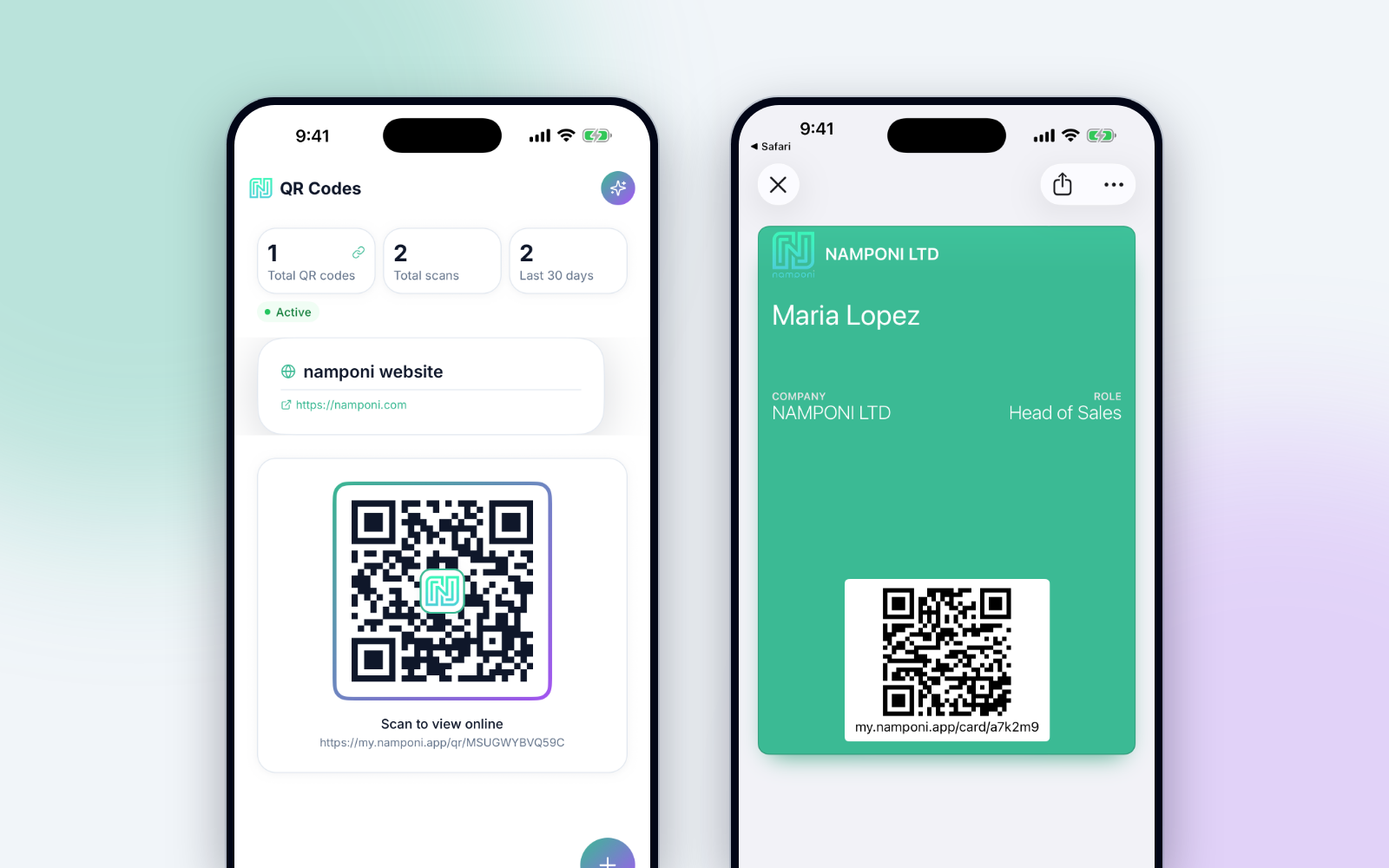
- One QR code for the booth. It goes on the stand, the table tent and the back of my laptop. It links to my digital card with a save-contact button, not to the homepage. I want a phone number saved, not a bounce.
- A digital card for each person on the team. Same company branding, personal details, one tap to share. The card has an offline QR so it works when the hall Wi-Fi does not.
- A wallet pass. The card goes into Apple Wallet or Google Wallet so I can share it from the lock screen with a phone in one hand and a coffee in the other. Visitors who add it keep me on their phone, not in a pocket.
- A shared organisation in the app. Everyone on the booth scans into the same list, tagged with the show name. Nothing lives on one person's phone.
- A lead source and two tags decided in advance. For this show:
Expo 2026, thenhotorwarm. Not fifteen tags. Two.
If you exhibit more than once a year, the events use case page goes deeper on team setup: roles, shared lists and how batch scanning works when the booth gets busy.
What is the ten-second capture routine at the booth?
When someone hands you a card, photograph it before the conversation ends, add one line about why they stopped, and tag them hot or warm. That is the whole routine. Done at the booth it takes ten seconds. Done at the hotel it takes ten minutes per card and you will skip half of them.
The order matters:
| Moment | What I do | Why |
|---|---|---|
| They hand me a card | Scan it while we talk | The AI reads name, title, company, email and phone. I do not type anything. |
| They say something specific | Write it on the card, or one line in the note | "Wants pricing for 30 users", "asked about HubSpot". Handwriting on the card gets read too. |
| Before they walk away | Tag hot or warm, source Expo 2026 | Two seconds now saves triage tonight. |
| They have no card | Show my QR or wallet pass | Their scan becomes a lead with their details, no typing for either of us. |
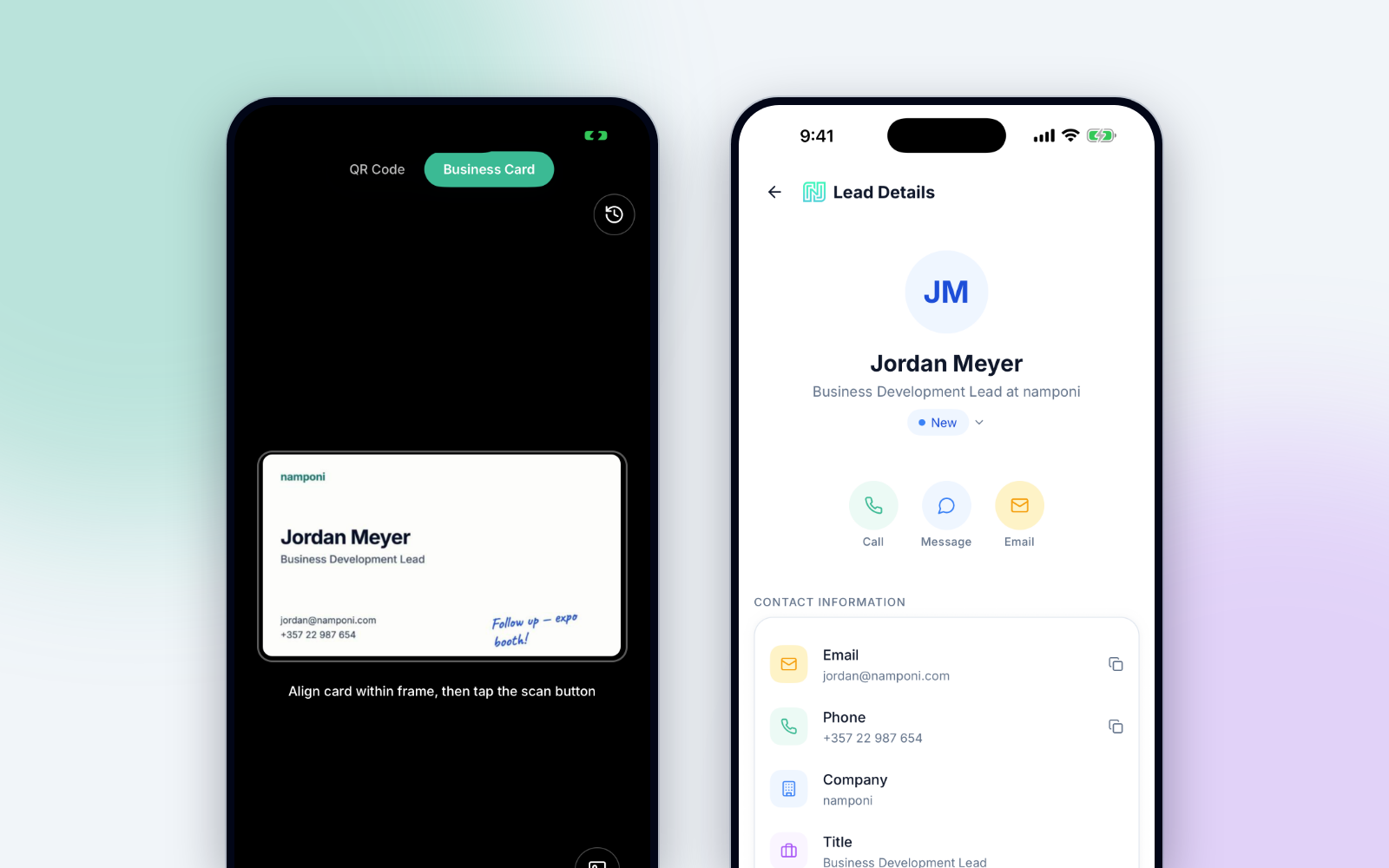
The point of writing on the card is that the note survives with the person. In the screenshot below, the visitor's card carries a scribbled "follow up, expo booth", and the lead that comes out of the scan already has the name, title, contact details and that note attached, with the booth recorded as where we met.
Three things I learned the hard way:
- Scan in batches when it gets busy. If four people arrive at once, photograph the cards and keep talking. The app processes them in the background and I add tags at the next quiet moment. The card scanning feature handles up to ten cards in one batch.
- Never promise "I'll send that over" without writing it down. The promise is the lead. If it is not in the note, it did not happen.
- Do not collect cards you will not follow up. A polite "let me scan that so I remember" beats a pocket full of guilt.
What should I do the same evening?
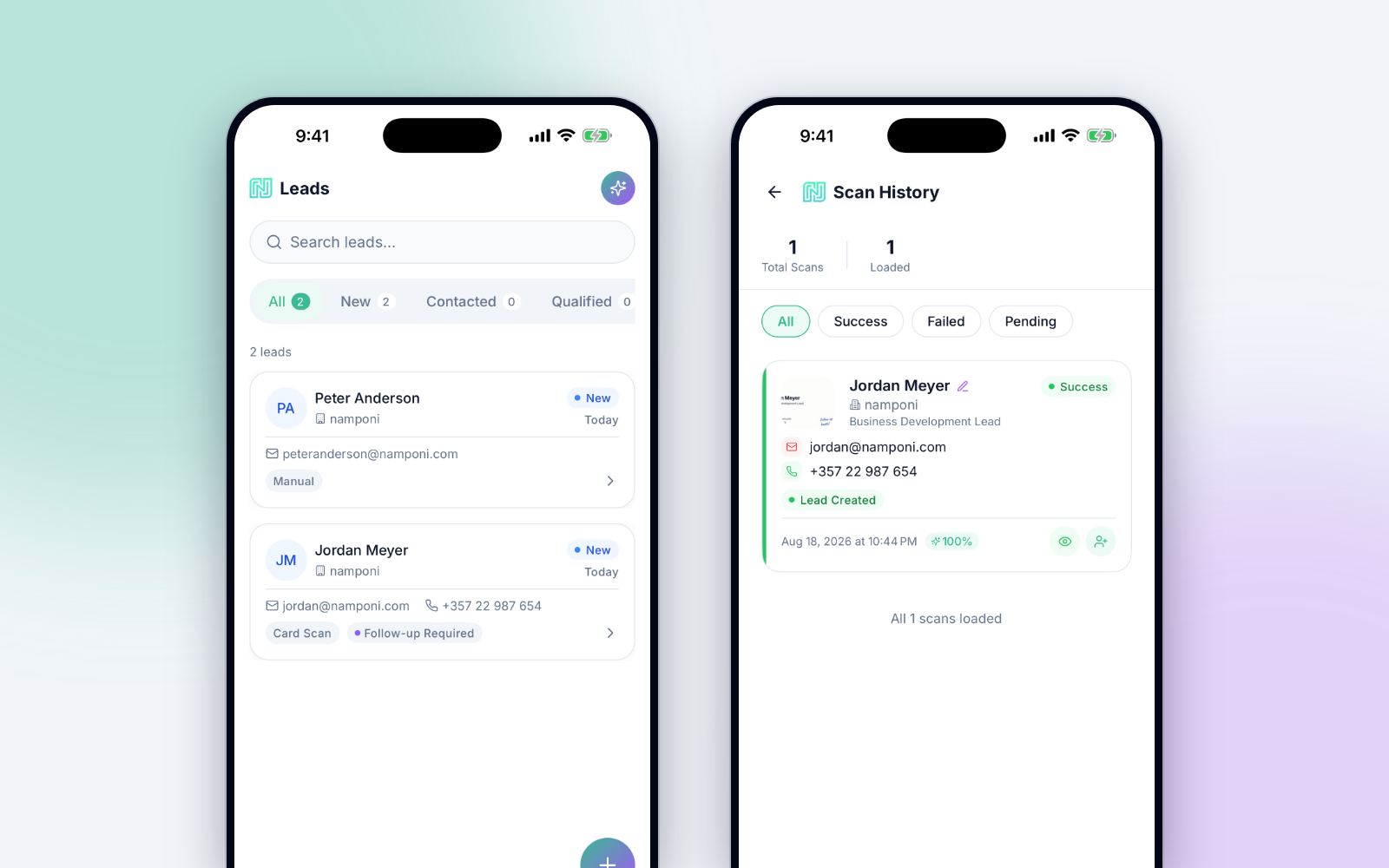
Spend twenty minutes at the hotel triaging the day's leads while you still remember the faces. Open the list filtered to today, check that every hot lead has a note and a next step, and fix anything the scanner misread. Do not write follow-up emails yet. Just make sure that when you sit down to write them tomorrow, everything you need is already there.
My evening checklist:
- Filter leads to today's date and this show's tag.
- For every
hotlead: does the note say what they wanted? If not, write it now from memory. Tomorrow it will be gone. - Glance at the scan history for anything that failed or came back with low confidence, and re-scan or correct it.
- Move anyone who clearly is not a fit to a
not nowstatus. A clean list tomorrow is worth more than a long one. - Look at how many scans the booth QR got today and where it was placed. If it was low, move the sign.
How do I follow up within 72 hours?
Send the first personal message to every hot lead within 72 hours of the show closing, and to warm leads within the week. Reference the note you captured, give them the thing you promised, and propose one concrete next step. Then get the lead out of the app and into whatever your team uses to track deals.
The sequence that works for me:
| When | Who | What |
|---|---|---|
| Day of the show, evening | Anyone who asked for something specific | Send the thing. Pricing, a link, a deck. No pitch, just the promise kept. |
| Day 1 after the show | All hot leads | Short personal email: where we met, what they said, one suggested time to talk. |
| Day 2 to 3 | All warm leads | Same email, lighter ask: "Happy to send more when it is useful." |
| Day 5 to 7 | No reply from hot leads | One follow-up. Add something new, do not just "bump". |
| Day 14 | Everyone still open | Move to your normal nurture. The show is over. |
The single most useful line in those emails is the one from the note: "You mentioned you were comparing this against HubSpot for a team of thirty." It proves you listened, and it is the reason to capture context at the booth rather than afterwards.
For the handoff, I push leads into the CRM rather than leaving them in the app. namponi syncs to Salesforce and HubSpot through the integrations, so a lead tagged hot at the booth shows up in the pipeline with its note, its source and the company details filled in from their email domain. If you use something else, export the list on day one. The point is that follow-up happens where your team already looks every morning.
How do I know whether the show paid off?
Tag every lead with the show it came from, then measure three things over the following quarter: how many replied, how many became meetings, and how many became customers. Compare that to the full cost of exhibiting, including your team's days. Without the source tag you cannot answer the question, and you will exhibit again on gut feeling.
The numbers I look at:
- Scans on the booth QR by day and hour. Tells me which placement and which day worked. The analytics screen shows scans, unique visitors and the device split, so I can also see whether people are saving my contact or just looking.
- Leads captured per team member per day. Not to rank people, but to spot whether one method or one position on the stand is producing more.
- Reply rate on hot versus warm. If warm leads never reply, I am tagging too generously and should be stricter at the booth.
- Meetings booked within 30 days, deals within 90. The only numbers the finance conversation cares about.
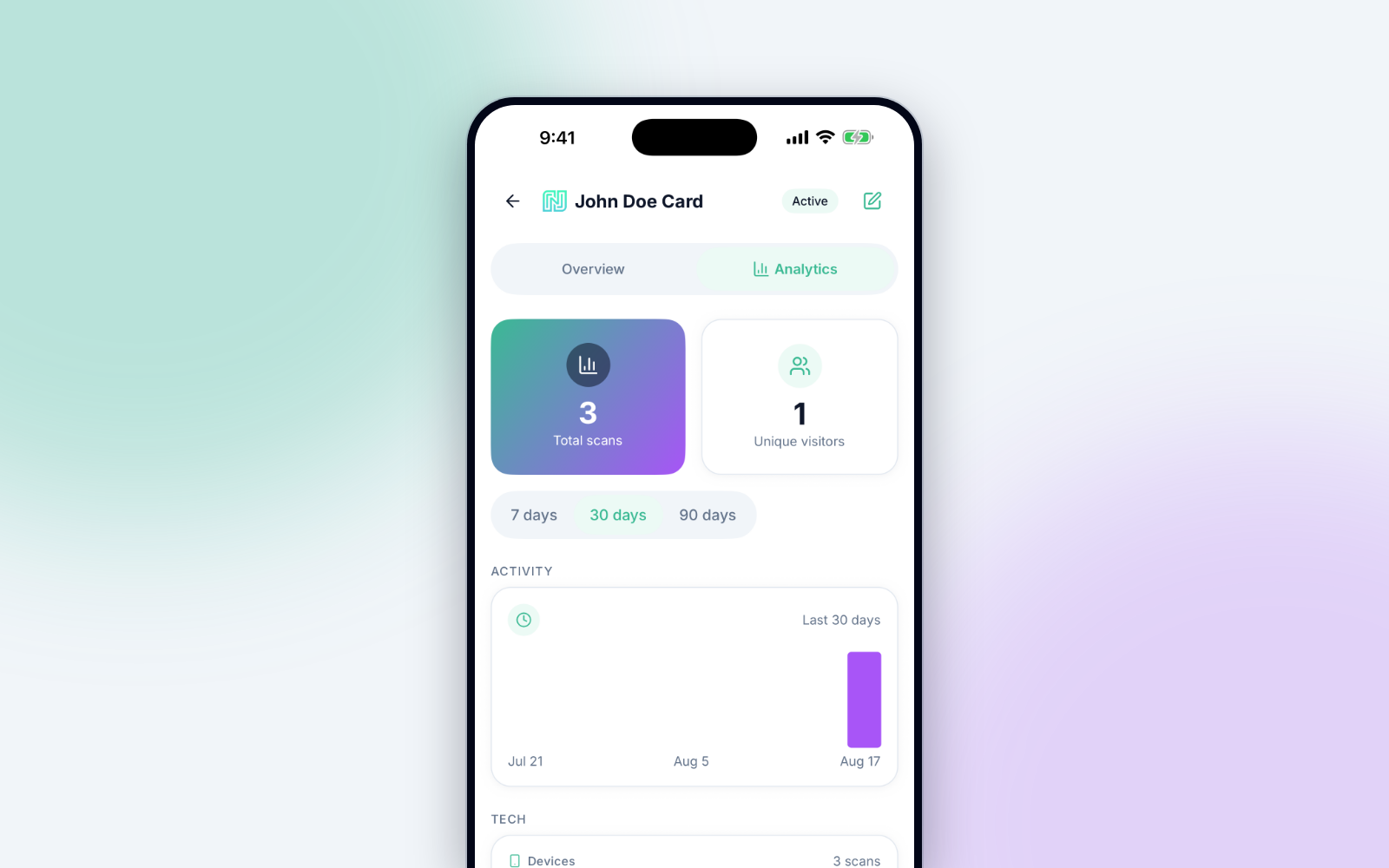
When the routine works, the end of a show sounds different. Instead of "we met loads of people", you can say how many you met, how many you captured with context, how many heard from you inside 72 hours and how many turned into meetings, and you know which day and which side of the stand produced them. That is the difference between a stack of cards and a lead list, and it is a routine, not a tool.
The one-page checklist
Print this, or save it to your phone.
Before the show
- One booth QR code that opens a card with save-contact, not the homepage.
- A digital card and wallet pass for each person on the booth.
- One shared list, one source tag for the show, two priority tags:
hot,warm. - Test the whole flow on the way there, on hall-quality mobile data.
At the booth
- Scan the card while you talk. Never afterwards.
- One line of context: what they asked, what you promised.
- Tag
hotorwarmbefore they walk away. - No card? Show your QR or wallet pass instead of asking them to type.
Same evening
- Twenty minutes: filter to today, complete the notes on every hot lead.
- Fix failed or low-confidence scans.
- Check booth QR scans and move the sign if they were low.
Within 72 hours
- Keep every promise first. Then one personal email per hot lead.
- Warm leads by end of the week. One follow-up after five to seven days.
- Push everything into the CRM with source and notes attached.
After 90 days
- Replies, meetings and deals from the show tag versus total cost.
- Decide whether to go back.
If you try this at your next show, I would genuinely like to hear how it went, including what did not work. You can reach me through the contact page or on the namponi LinkedIn page.
Frequently asked questions
How quickly should I follow up after a trade show?
Send the first personal message within 72 hours of the show closing, and ideally the same or next day for anyone you tagged as hot. Speed matters more than polish: a short note that references what you actually discussed beats a polished template a week later.
Is scanning business cards with an app better than collecting them?
Yes, if you scan at the booth rather than afterwards. Scanning while the conversation is fresh lets you attach context, a tag and a next step in seconds. A stack of cards scanned a week later has lost most of that information.
What should I put on my booth QR code?
One destination that does one job: your digital card with a save-contact button, or a short form that captures name, email and one question. Do not send people to your homepage. Track the scans so you know which placement and which day worked.
Do I still need paper business cards at a trade show?
Carry a few, because some people will still hand you theirs and expect one back. But lead with a QR code or wallet pass: the visitor keeps you on their phone, you get a scan you can measure, and nothing ends up in a drawer.
How do I know whether a trade show was worth it?
Tag every lead with the show it came from, then look at those leads three months later: how many replied, how many became meetings, how many became customers. Compare that to the total cost of exhibiting. Without the source tag you are guessing.